
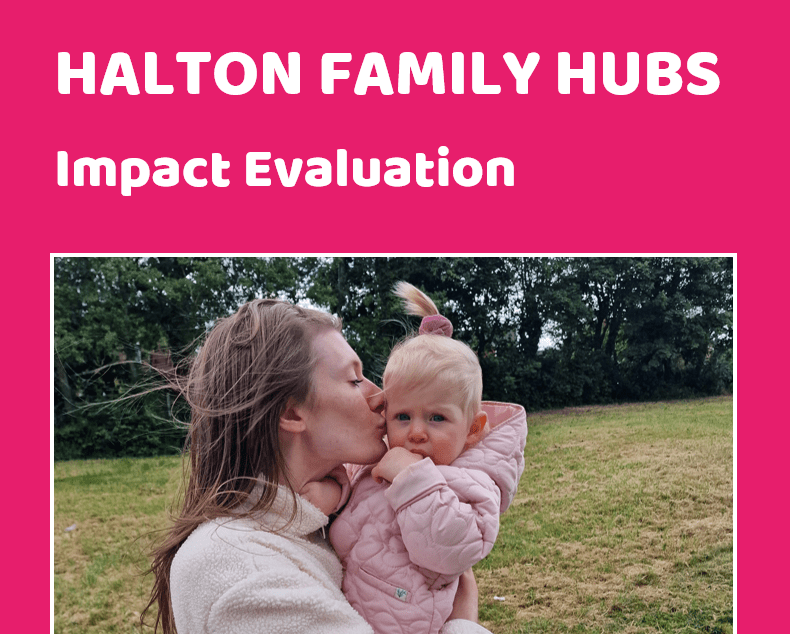
What our evaluation of Halton Family Hubs taught us…
Spoiler alert…yes. At least in our humble opinion, having done many evaluations which often boil down to ‘how are people experiencing a service?’ or in other words:
- What’s good?
- What’s not good?
- What can we change/improve?
We may talk about ‘how can we demonstrate that this person is experiencing a positive outcome as a direct result of our service?’, but the reality is most of the time we are working in contexts where this is pretty impossible to prove in any kind of robust way.
Evaluating Family Hubs
Take our recent evaluation of Halton Family Hubs. The service had grown and transformed significantly in the last couple of years and Halton Borough Council were keen to carry out an evaluation to understand impact, explore in what ways the new offer was supporting families, and how they could continue to build on this.
As part of this we travelled to Halton and spent a couple of days visiting Family Hub sites and chatting to families, as well as speaking to staff. We also used our trusty favourite, Field Notes, to use digital ethnography approaches with families and capture their lived experiences of the service through voice notes, images and videos.
In total we interviewed around 20 professionals including strategic and operational staff and commissioned partners, engaged with around 30 families using the hubs in-person, did an online survey receiving around 60 responses, and in-depth digital engagement with 8 parents. We captured a huge amount of learning, with families reporting overwhelmingly positive experiences about the service.
This was the kind of ‘real world’ evaluation we love doing, with minimal time spent on process design or developing complex frameworks (that nobody ever really wants to look at). Of course we had theories of change and the usual necessities, but we jumped straight in and just started asking questions.
I’ve attended many a training session or webinar led by academics who use a lot of big words and fancy frameworks around demonstrating causality or how to make evaluation rigorous, but am left thinking…that’s just not realistic for most of the work we do in the public and voluntary sector.
There can often be so much focus on achieving the ‘gold standard’ of evaluation, to try to prove beyond doubt that ‘X caused Y’…but is it actually all that important?
We did however, hear from families things like: “I don’t know what I would have done without this service”, or “This session saved my sanity”, or even “It’s changed my life.”
Now, it’s very difficult to evidence at scale that one particular Family Hubs session means that X number of families in Halton achieved X outcome or even that this early intervention avoided the need for a more acute service down the line, which of course would be the ideal, but these kind of stories speak for themselves.
What is actually going to make a difference?
In our experience, it comes down to what’s USEFUL? What does the client actually NEED that is going to help them move forward in a practical way?
There will always be a place for numbers, and for this evaluation we also analysed service data to evidence impact in quantitative ways where this was available, but it’s not always possible. So much of the work services like Family Hubs are doing is based on building relationships with communities, and as we heard from staff, it can be a slow burn.
The kind of outcomes families experience appear over many months or even years, and affect lives in ways that aren’t easy to attribute to ‘one thing’.
But I think it would be difficult to listen to the clip below and not feel the impact and value that services like this can have for families…and these stories are just as valid as the ‘hard’ data.
Ultimately, we were able to capture many stories like this one from families across Halton as well as their thoughts on what more is needed, together with learning from staff.
This then enabled us to develop tangible learning and actions which Halton have been able to act on straight away to make positive changes and keep improving the service. And isn’t that what it’s all about?
Our full report for the Halton Family Hubs evaluation can be found here, and you can watch our summary video below.

 SMPL Research
Leave a comment