
Why we won’t be ditching IRL research anytime soon…
We’ve all experienced that dreaded moment when you’ve launched your survey, sent out your interview invites or done a newsletter shout out, waiting for eager participants to come flooding in…only to receive a light drizzle at best.
Even worse, you’re up against the clock, and you’re not confident that any of your usual recruitment strategies are going to cut it.

Luckily, when we carried out an evaluation for Leicestershire Police last year to explore the impact of their behaviour change campaign, we anticipated this, and were able to factor it into our research design.
Leicester’s ‘Walk Away’ campaign was focused on reducing violence in the night-time economy, and the target audience was men aged 18-35. Historically, a group who aren’t usually the first to volunteer to take part in research.
For the evaluation, we’d analysed violent crime data, done a pre and post-campaign survey and interviews with people working in the night-time economy in Leicester, and a public survey with men in the city. But we wanted to go deeper, and speak directly with young men to get a better understanding of their thoughts and feelings on the campaign.
We used a mix of panel and organic responses for the survey, reaching out to more Facebook groups than we’d care to count as part of our promotional efforts to reach the men of Leicester. But as ‘out of towners’ with limited contacts in the area, we knew we’d have to do more to engage on a deeper level.
So we gathered up our clipboards, post-its and pens, booked our train tickets, and pitched up to the University of Leicester who had generously arranged a prime spot for us to catch students coming and going from the library and canteen.
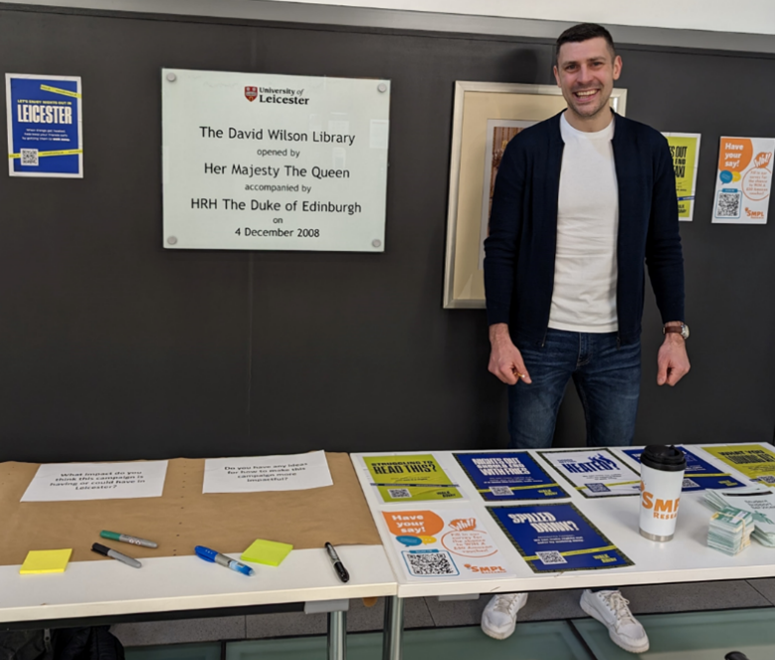
We had a few simple questions for students on our table, materials from the campaign, and posters with a QR code linking to our online survey.
Within a few hours, by accosting people with clipboards around campus or enticing them over to our table, we’d engaged with around 60 students. We won’t lie, the prize draw entry to win a £100 voucher definitely helped, but people were generally happy to stop and chat.
We had some great conversations and spoke to a diverse range of male students, capturing their views on how safe they feel in the city, whether they recognised the campaign, their thoughts on the messaging and how far the campaign could influence behaviour, and ideas for how it could have more impact.
Leaving with our clipboards full of scribbled notes, we’d gained a huge amount of insight in a short space of time, having meaningful conversations with people in a way that wouldn’t have been possible without meeting people where they were ‘in real life’.
It also gave us a chance to spend some time exploring the city, get a sense for the ‘vibe’ of the place, and understand the different areas people were talking about, which all helped to add context for our evaluation.
And of course, it would have been rude not to sample a little of Leicester’s nightlife for ourselves by stopping for a drink or two and a bite to eat before hopping on the train back to Essex.
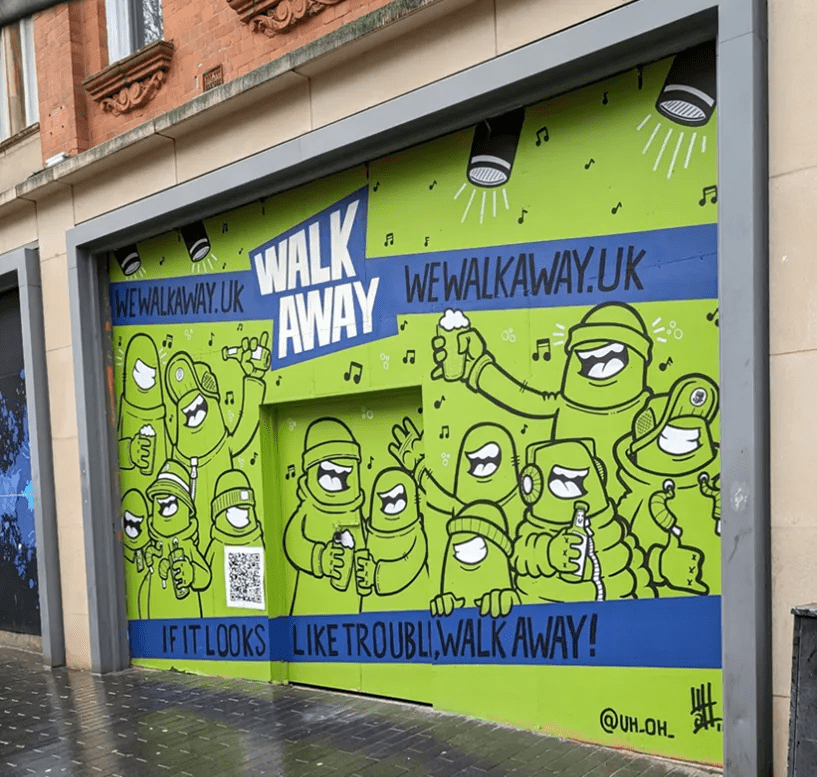
So, whilst there’s naturally been a shift to online research as the default since the pandemic, and it definitely has its advantages in providing both flexibility and new creative methods, face-to-face research isn’t dead.
Sometimes, you just can’t beat holding something in front of someone, asking “what do you think of this?”, and putting a pen and a post-it note in their hand.
We’d love to hear your thoughts on when in-person research is most helpful, and what you think it offers that you just can’t get from virtual approaches?
More about the Walk Away campaign
Since its launch and our evaluation, the Walk Away campaign has been rolled out to over 20 other police forces in the UK, and won an award for Best Marketing and Branding Scheme at the Town and City Management Industry Awards 2024. Find out more.
If you’d like to know more about our evaluation or just want to chat, get in touch at hello@smplresearch.co.uk.

 SMPL Research
Leave a comment